
Roosevelt County Parole Versus Probation
Parole and probation both allow a person to live outside a jail or prison while following legal conditions, but they begin in different ways. Probation follows a court sentence. It may start without any state prison term, or it may follow a short custody term. Parole is conditional release tied to state imprisonment and parole authority. A person on either form of supervision has left physical custody, yet the sentence or supervision term is still active.
A bond release from the Roosevelt County Detention Center is not parole or probation by itself. The court must separately impose probation or another form of supervision. Likewise, a transfer from the county jail to the New Mexico Corrections Department is not a community release. The person remains in custody even though the name may no longer be available through a local jail channel.
| Record point | Parole | Probation |
|---|---|---|
| How it begins | Conditional release connected to a state prison sentence | Sentence ordered by a court, sometimes without a prison term |
| Local administration | NMCD Probation and Parole Division | NMCD Probation and Parole Division when assigned there |
| Decision source | Controlling sentence and parole authority | Judgment and sentence from the court |
| Best first check | NMCD Offender Search, then displayed office | NMCD Offender Search plus the court docket |
| End of status | Official discharge or completion entry | Official discharge, completion, or court action |
- Discharge
- The official end of a custodial sentence or supervision term.
- Absconder
- A supervision status alleging that a person stopped reporting or cannot be located as required.
- Detainer
- A request or hold from another authority that may block release or lead to a transfer.
Verify Roosevelt County Post-Release Supervision
The NMCD Offender Search covers people incarcerated by NMCD and people on probation or parole. It does not cover an ordinary county or city jail stay. The search accepts a first name, last name, or NMCD number. Its live form also offers Active, Include Inactive, and Absconder Only choices. Probation and parole data update in real time, but NMCD still directs users to verify location and legal status with the institution or supervision office.
Use a careful match. A common name is not enough, and an inactive filter is not proof of discharge. Open the individual result and copy the exact status term, NMCD number, supervising region or office, and the date checked. A disappearance from search results can be a technical issue. It does not establish that parole or probation ended.
- Search by the legal first and last name. Use the NMCD number when known because it is the strongest public identifier.
- Open the matching record and compare all public identifiers. Do not rely on the name alone.
- Record the precise custody or supervision wording. Distinguish parole, probation, inactive status, prison custody, and absconder status.
- Note the listed location or supervising office. A Roosevelt County person may be assigned to the Portales District Office or another office.
- Call the displayed office when the legal status or location must be confirmed. Check the court judgment when the result and expected sentence do not align.
The official live NMCD search form shows how Active, Include Inactive, and Absconder Only filters are separated.
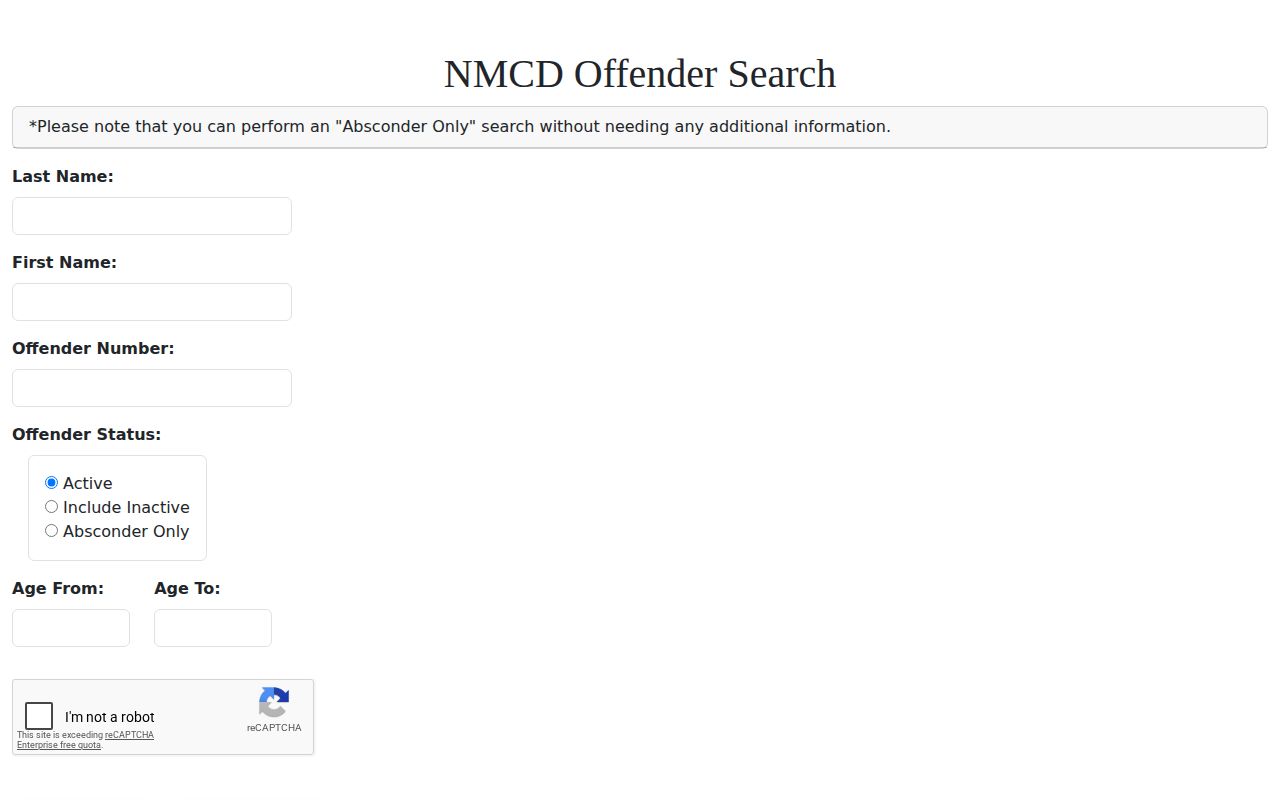
Those filters help narrow a supervision check, but the opened person record and responsible office remain the sources for the actual status.
Note: An “inactive” search choice broadens the query; only the matched record and agency confirmation establish why a status changed.
Roosevelt County Parole Office Route
NMCD Region IV covers eastern and southeastern New Mexico, including Portales and the Ninth Judicial District. The local point of contact is Portales District Office 9A. This gives Roosevelt County residents a direct office for checking a displayed supervision assignment rather than relying only on a statewide line. Call before visiting because the researched page did not state public-counter hours.
NMCD Portales District Office 9A1116 N. Chicago
Portales, NM 88130
575-359-0295
Statewide probation/parole: 866-416-9867
The office can verify whether its district supervises the matched person and whether the public status remains current. It cannot turn a county jail release into a parole record when no state supervision exists. For the wider custody and release trail, the Roosevelt County released-inmate search path separates the county record, court docket, and state system.
Roosevelt County Absconder Status
An absconder flag means alleged noncompliance and possible arrest authority. It does not cancel the earlier release from physical custody. The NMCD search has an Absconder Only filter and a region choice, while NMCD also publishes “Most Wanted” material. Such material is not a full list of every person who may have stopped reporting. Old files must be date-labeled and checked against the live search.
A warrant and an absconder label also answer different questions. The court docket may show warrant activity, while the supervision record shows how NMCD classifies the case. If the person is arrested again, the result can shift from community supervision to jail or prison custody. Confirm any urgent safety or warrant question with the displayed agency or local law enforcement rather than inferring it from an old document.
Note: NMCD directs tips about wanted people to its Response Center or local law enforcement, not to a records-request office.
Roosevelt County Parole Decision Records
The New Mexico Parole Board decides parole matters within its legal authority. It is administratively attached to NMCD but acts independently in that decision role. The Probation and Parole Division supervises people after release. This split matters when checking a Roosevelt County parole record: a Board action may explain the legal decision, while the NMCD status and release record establish whether and when the person actually left prison.
The Board says individual offender hearings are closed except for participation allowed to victims by law. Its public calendar and archived agendas concern quarterly public Board meetings, not a searchable list of individual inmate hearings or results. No official public person-level decision database was found. The Board’s records-manager or IPRA process is the public route for an available decision record.
Under the cited Board rules, a majority of two members may grant, deny, revoke, set conditions, or approve a plan. A two-member tie goes to the full Board. The person is usually told of a regular-hearing decision within five working days unless more time is required for conditions or plan approval. A grant may have conditions and an effective date, so it still does not prove physical release on the decision day.
The Board reports weekly hearings at several correctional facilities and an average of about 300 regular and revocation hearings per month. Final revocation hearings begin on the third Wednesday of each month and can continue on Thursday and Friday when needed. These facts describe the Board’s work pattern, not an open calendar for a named person. Eligibility comes from the controlling sentence, judgment, and applicable law, including NMSA 1978 § 31-21-10 and, when relevant, § 31-21-10.1. Offense-specific provisions and the version of law governing the sentence may change the result.
Roosevelt County Release Reentry Support
Roosevelt County has a local release-transition resource at the detention center. The RCDC Medication Assisted Treatment program began in 2021 and describes therapy, discharge services, and reentry support that extend from incarceration through release. Its purpose is continuity of care and support during a period when a person may face a high risk of relapse or overdose.
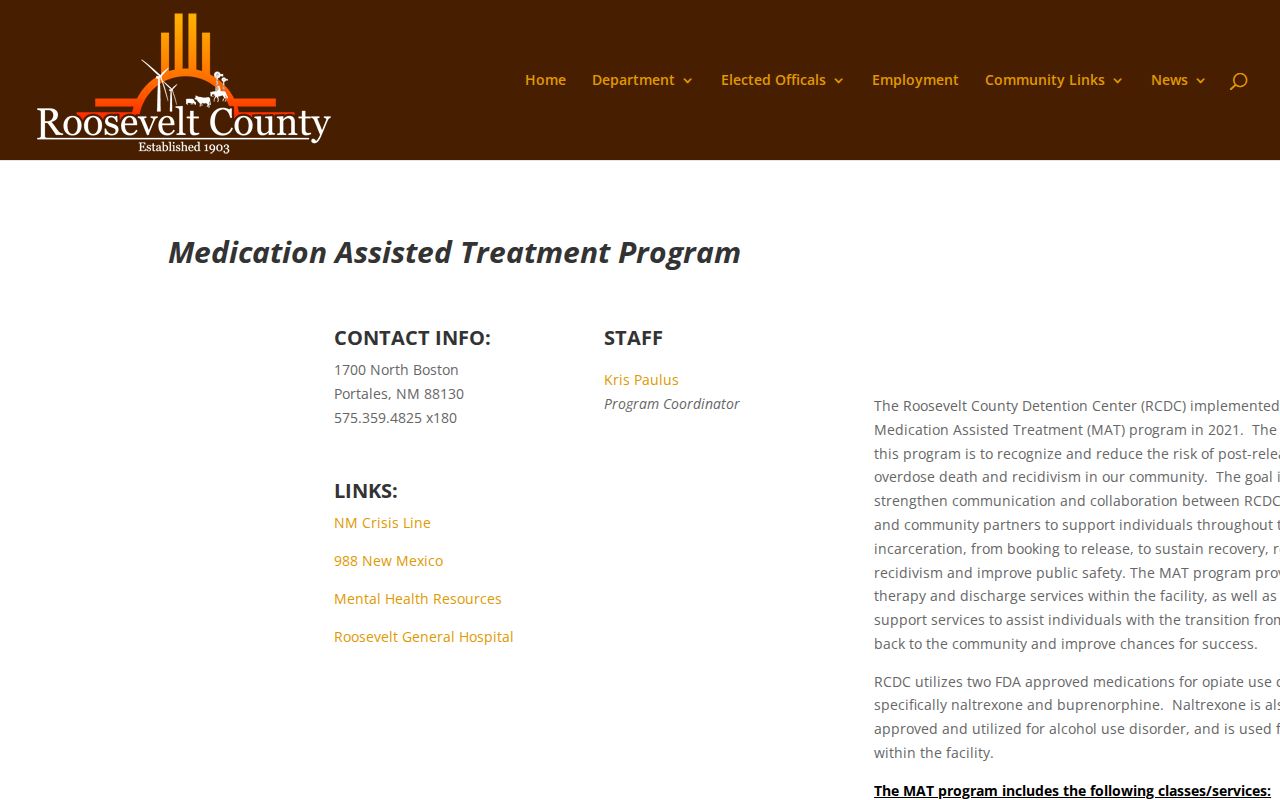
The local program contact is 575-359-4825 extension 180. Program participation does not establish parole or probation status. It is a distinct discharge and reentry route connected to the county detention episode.
Someone leaving RCDC may return to the community on bond, after time served, after dismissal, or on probation. Another person may transfer to NMCD rather than return home. The program can support a transition, while official custody and supervision records still control the legal status.
Roosevelt County Supervision Discharge
Supervision ends through an official discharge, completion, or other controlling legal action. Absence from a current search is not enough. First confirm identity and the search date. Then compare the NMCD record with the judgment and sentence, any later court orders, and the assigned office’s information. The general state retention schedule treats parole and probation files as permanent records, with archival transfer after the stated period following completion of supervision, but retention does not mean every part is public online.
New Mexico VINE may provide custody-change alerts, but it is not a complete supervision file. The official state page also separates VINE registration from the written notification system for victims of violent crime. Those victims must register through the prosecuting District Attorney for written parole-hearing and NMCD-release notices. A VINE registration alone does not create that separate registration.
When an exact end date matters, ask for the discharge or completion record and cite the person’s full name and NMCD number. If the matter began with a Roosevelt County court sentence, obtain the filed court order as well. Precise records are more reliable than an assumed end date based on a missing search result.
The New Mexico Department of Public Safety registry is another distinct system. It covers only people who have a statutory registration duty and is not a general parole, probation, or release list. Presence there does not prove the date of release, and absence does not prove unconditional discharge. Use the registry only for the narrow status it reports, then return to NMCD and the court record for supervision facts.