
Roosevelt County Three-Day Releases
The official Roosevelt County Detention Center page does not offer a live roster, a released-person tab, or a rolling 72-hour feed. It also gives no update schedule for such a list because the list does not exist. The reliable substitute is a historical extract from the jail register for a defined three-day span. That extract should identify each departure recorded by RCDC during the requested period, subject to lawful redaction.
A three-day result must be read with care. Release from RCDC means county custody ended. It does not always mean the person returned to the community. A transfer to NMCD, another jail, the U.S. Marshals, BOP, or ICE continues custody under a new agency. Escape and death are also distinct events and should never be counted as ordinary community releases. The release reason, authority, and receiving agency supply that missing context.
No official Roosevelt County 72-hour web feed exists. Use a dated county record extract and verify transfers with the receiving agency.
Request Roosevelt County 72-Hour Releases
Define the window before contacting the county. Give a start date and time, an end date and time, and state that the interval uses Mountain Time. “The last three days” can shift while a request is processed. Fixed timestamps preserve the same period for both the requester and custodian. They also reduce the chance that a late-night release falls outside an unclear date-only request.
Use this sequence to build the interval:
- Choose exact beginning and ending timestamps spanning 72 hours in Mountain Time.
- Call RCDC at 575-356-6871 only for a narrow, immediate custody or release question.
- Submit a written request through the Roosevelt County NextRequest portal for jail-register release entries in that period.
- Ask for actual release time, booking identifier, release reason or authority, charges or court, and the receiving agency when public.
- Record when the request was made and label the response as a historical extract, not a live feed.
- Follow every transfer entry into the system named as the receiving custodian.
For a same-day interval instead of a weekend-sized view, use Released Last 24 Hours. The two requests serve different needs. A 24-hour query is tightly focused, while a 72-hour request is designed to catch a longer run of processing and delayed record entry.
Roosevelt County Release Record Fields
Because there is no online table, these are fields to request from the county rather than fields promised on a public screen. Some information may be redacted or withheld under New Mexico law. Ask for the fields that distinguish a person, the correct custody episode, and the outcome of departure.
| Requested field | What it establishes |
|---|---|
| Legal name and booking identifier | Connects the entry to one person and one jail episode. |
| Booking date and time | Separates the start of custody from the later release event. |
| Actual release date and time | Shows when physical custody at RCDC ended. |
| Release type and authority | Distinguishes bond, time served, court order, probation, discharge, or transfer. |
| Charges, court, and case number | Connects the jail event to the lasting court docket. |
| Destination or receiving agency | Shows whether custody continued with another jail, NMCD, BOP, USMS, or ICE. |
A projected, tentative, or scheduled date is not a substitute for the actual release timestamp. Those dates can move because of court action, sentence credit, a hold, or another case. The completed jail entry is the local source for departure from RCDC, while the court or receiving agency explains what followed.
Weekend Roosevelt County Release Timing
The wider window is most useful when office closures or routine processing break up a same-day search. A Friday-through-Monday interval, for example, can gather several calendar days into one request. Do not assume that Roosevelt County uses a special weekend release schedule. No official weekend or holiday release rule was found in the research. The point of the longer window is coverage, not a claim that releases occur at a set hour.
A court order may appear before the person physically leaves the facility. VINE can also lag behind the source record. Data entry may be corrected after the event. For those reasons, compare the file-stamped court action with the jail's actual departure time. When the question concerns one named person rather than everyone in a time range, the Roosevelt County released inmate search path explains how to reconcile the jail record, court docket, and later custody or supervision record.
Neither a hearing calendar nor a daily booking sheet is an adequate replacement. A hearing may not produce release, and a booking list records arrival rather than departure. The requested three-day release register is the record designed around the relevant event.
Boundary choices also matter when comparing two three-day periods. Use a start that is inclusive and an end that is exclusive, then state those terms in the request. The next interval can begin at the prior interval's exact end. That method avoids counting a departure twice or leaving an unsearched gap between requests. Keep the county response date separate from the event window. A record received later still describes the fixed dates requested, and any later correction should be saved with the first extract rather than silently replacing it.
Verify Roosevelt County Release Outcomes
Use the release type as the first routing clue. Bond, recognizance, time served, dismissal, or probation may indicate a return to the community, though another hold can change the result. A transfer means custody continues. Parole applies to conditional release from state prison and is not the same as a county bond release. “Discharge” can refer to completion of a sentence or supervision, depending on the agency's own wording.
Match the event through the appropriate official channel:
- Use the RCDC booking and release record to confirm departure from the county facility.
- Review New Mexico Case Lookup for bond, dismissal, judgment, commitment, probation, or warrant activity, then obtain the filed order when exact terms matter.
- Search NMCD when the county entry identifies a state transfer or state supervision.
- Use BOP for a designated federal prisoner, USMS channels for federal pretrial movement, and ICE ODLS after an immigration transfer.
- Treat a VINE notice as an alert that still requires confirmation from the originating jail or institution.
NMCD expressly has no jurisdiction over county or city jails. Its offender search cannot replace a Roosevelt County release record. A state result becomes useful only when the facts point toward NMCD custody, parole, or probation.
Roosevelt County Release Record Retention
Roosevelt County presents a useful records distinction. Its detailed detention page links to VINE and detainee services, yet it offers no current roster or recent-release archive. The absence of a web entry does not prove release. It also does not show that the underlying jail file has been destroyed. Public display and government retention are separate questions.
The New Mexico general records-retention schedule, at Rule 1.21.2.902 NMAC, provides for destruction of a jail inmate file five years after closure. Retention does not make every part public. Juvenile, medical, security-sensitive, sealed, and other protected material may be withheld or redacted. Still, the schedule creates a practical historical route after the 72-hour window has passed: ask for the closed custody episode instead of searching for a web archive that Roosevelt County does not publish.
The official detention page documents the absence of the expected online list. The Roosevelt County Detention Center page shows facility contacts and detainee services but no 72-hour release feature.
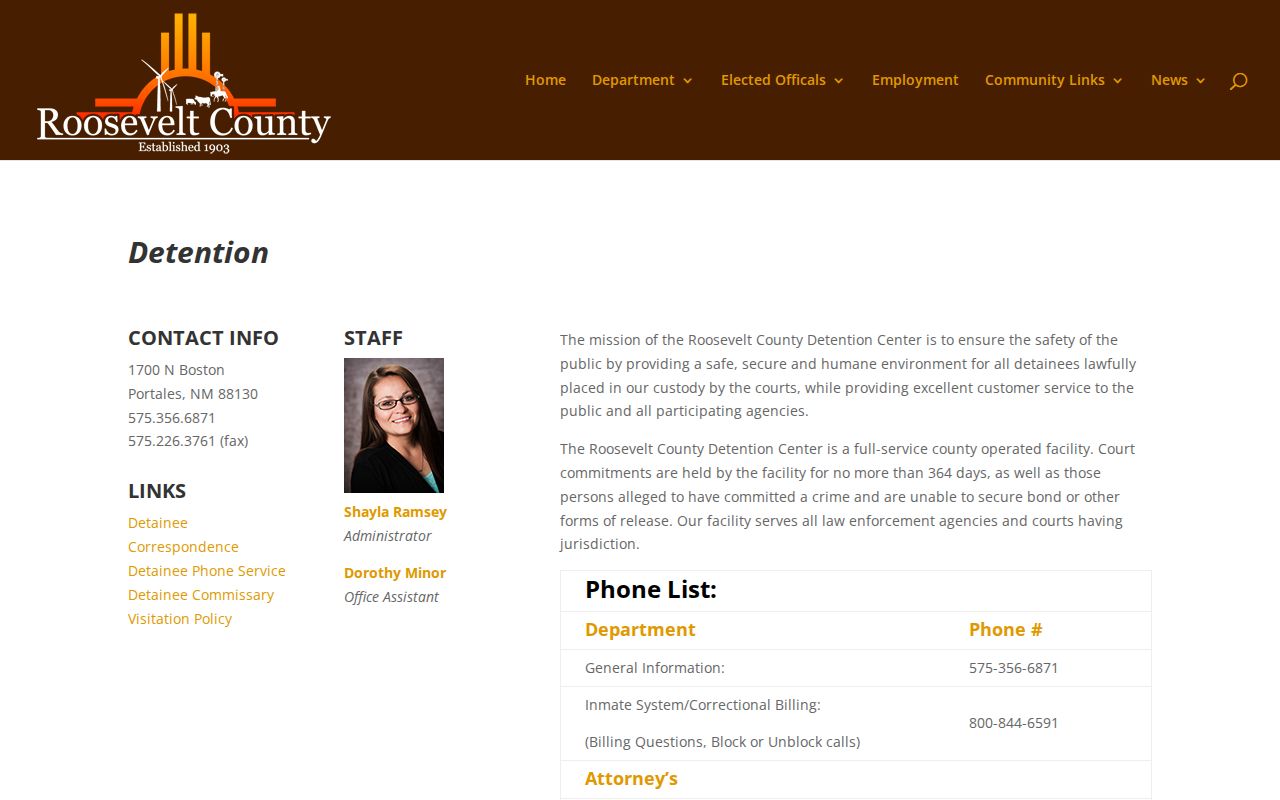
The captured official page supports using RCDC and the county records process rather than claiming that a rolling list is available.
Roosevelt County Release Request Rules
Roosevelt County accepts oral and written public-record requests, but the statutory procedures and remedies apply to written requests. Include the requester's name, address, email address, and telephone number. Describe the 72-hour interval and desired release-register fields with enough detail for the custodian to locate the record. A narrow request is less likely to trigger an excessive-burden notice.
The county says inspection must be allowed immediately or as soon as practicable, no later than 15 calendar days. If inspection is not available within three business days, the requester should receive a written notice explaining when the records or response will be available. A denial must give its reason within the same outside period. Broad or burdensome requests may take additional reasonable time after written notice.
Administrative-office charges may reach $1 per paper page at 11 by 17 inches or smaller, $10 per CD, and $20 per DVD under the current fee resolution. Advance payment may be required. Electronic delivery can reduce cost, but a digital jail record is not guaranteed to be free. Confirm format and price before ordering.
Send a written request to the Records Custodian, Roosevelt County Administration, 109 W. First St., Portales, NM 88130, or use NextRequest. The listed fax is 575-356-8307. Ask the custodian to cite the legal basis for any withheld field, and keep the response with the dates of the requested interval.
Note: A county release extract documents departures during the selected span, but later corrections and receiving-agency records may change how each event is understood.